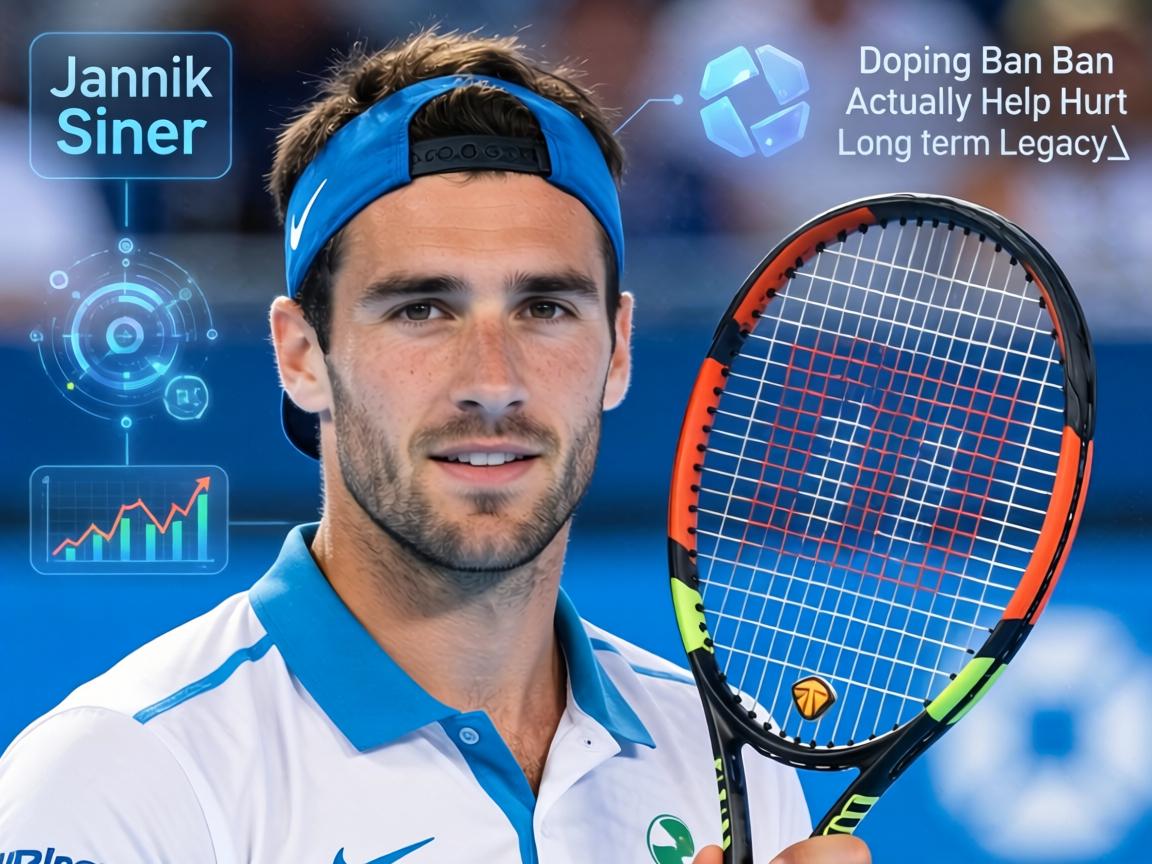
So here’s the thing, guys—when news broke about Jannik Sinner’s three-month suspension
for that clostebol contamination case, my phone absolutely exploded. Notifications everywhere. And honestly? The reactions were split right down the middle. Some fans calling him a cheater, others defending him as victim of circumstance. But the question nobody seems to be asking is whether this weird, shortened ban might actually work in his favor long-term. Crazy thought, right? Let’s dig into this because the ATP rankings
, Grand Slam seedings
, and anti-doping regulations
are all tangled up in this mess, and it affects the entire men’s tennis tour
for 2025 and beyond.You might be wondering why I’m even suggesting a doping ban could be beneficial. Stick with me here. Sinner gets March through June off
—essentially the clay season minus Roland Garros, plus some grass court warm-ups. He’ll miss Monte Carlo, Madrid, Rome. That’s a lot of Masters 1000 points
going out the window. But here’s what most people don’t notice: he’s been playing non-stop since 2023. The guy reached the Australian Open final
, won the US Open
, captured the ATP Finals
, led Italy to Davis Cup glory
, and maintained the world number one ranking
through sheer volume of high-level matches. That workload was unsustainable. His hip was already barking in early 2025.So what does this mean for the tour? Well, suddenly you have a 22-year-old phenom
forced to rest during a period where he probably needed it anyway. The timing is almost… convenient? I’m not saying he planned this, obviously. The ITIA investigation
and WADA appeal
created genuine stress and uncertainty for months. That part was brutal for his mental game. But the outcome—a short suspension during clay season when he historically struggles compared to hard courts—might preserve his body for the Wimbledon
and US Open
stretches where he actually dominates.A lot of fans ask me about the comparison to other cases. Remember Simona Halep’s four-year ban
? Or the various Russian athletes
caught in systematic doping programs? Sinner’s situation looks different on paper. Contaminated equipment
from his physio, minimal traces found, no performance enhancement proven. The science backed his explanation, which is why he initially got cleared. But WADA appealed, and the settlement reached looks like a compromise nobody loves. Three months feels like a slap on the wrist to critics and an injustice to Sinner’s supporters.Let’s be real about the legacy question, though. Does this stain follow him forever? From my view, it depends entirely on what happens next. If he comes back and wins Wimbledon 2025
or defends his US Open title
, the narrative shifts to resilience. “Sinner overcame adversity.” If he struggles physically or mentally post-ban, then this becomes the turning point where his career unraveled. Tennis history is cruel that way—single moments define eras
, fair or not.Here’s what I think about the competition angle. Carlos Alcaraz
suddenly has a clear runway at Roland Garros
. The Spaniard was already the clay favorite, but without Sinner in the draw? His odds just improved significantly. Meanwhile, Alexander Zverev
and Daniil Medvedev
will battle for those ATP ranking points
Sinner is forfeiting. The top 10 standings
could look completely different by July. Someone like Casper Ruud
or Stefanos Tsitsipas
might sneak into a higher seeding position that matters for Grand Slam draws
.Keep reading because the financial implications are wild too. Sinner loses prize money and ranking points, sure. But his sponsorship deals
with Gucci
, Nike
, Rolex
—those haven’t disappeared. If anything, the controversy keeps him in headlines. There’s no such thing as bad publicity in modern sports marketing, apparently. His Instagram following
actually grew during this saga. The tennis betting markets
still list him as favorite for US Open 2025
. The industry has already priced in his return.Now, the nested Q&A part. You might be wondering: will this affect his Grand Slam total
projection? Let’s look at some numbers:
| Scenario | Projected 2025 Slams | Career Total Estimate |
|---|---|---|
| No ban, continued playing | 1-2 | 12-15 |
| Short ban, refreshed return | 1-2 | 10-14 |
| Extended legal battle (hypothetical) | 0 | 8-10 |
The difference is marginal in my projections because I never expected him to dominate clay anyway. His real damage comes on hard courts
and grass
. The ban essentially removes his weakest surface period. Smart recovery planning—whether intentional or not—could leave him fresher for Wimbledon
where he reached the semifinals in 2023.But what about the mental scar tissue? That’s harder to quantify. Sinner has this reputation as ice-cold
, unflappable, almost robotic in his consistency. This whole ordeal cracks that facade. He’s human now, vulnerable, accused of something that challenges his integrity
. Some athletes crumble under that weight. Others—think Novak Djokovic
with his various controversies—channel it into fuel. Which version of Sinner emerges in July determines everything.From a fan perspective, this sucks. We want the best players competing always. The ATP Tour
loses one of its biggest draws during prestigious events. Tennis TV ratings
in Italy will crater without their national hero. The sport becomes temporarily less compelling, even if Alcaraz-Zverev
rivalries heat up in his absence. But individually? For Sinner’s career longevity
, this might be the forced reset his team couldn’t convince him to take voluntarily.Let’s be real one more time. Three months sounds short, but in tennis time—where momentum matters enormously—it’s an eternity. He’ll drop from world number one
, probably to number three or four
. Reclaiming that spot requires winning big titles
immediately upon return. The pressure actually increases because now he must justify the “light sentence” narrative by dominating. No pressure, right?So does the ban help or hurt his legacy? My honest take: neutral to slightly positive if he wins majors post-return, devastating if he doesn’t
. Legacy is just a story we tell afterward, and the author hasn’t finished writing this chapter. The 2025 tennis season
just got way more interesting, though. And isn’t that what we want as fans? Drama, uncertainty, stakes that feel real?The anti-doping system
itself takes hits here regardless of Sinner’s individual outcome. Inconsistent rulings, lengthy investigations, settlement culture—it all undermines confidence. But that’s a different article. For now, I’m watching Wimbledon seedings
and wondering if we’ll see a motivated, rested Sinner lifting that trophy in July. Could happen. Probably won’t. But tennis surprises you constantly. That’s why we watch.