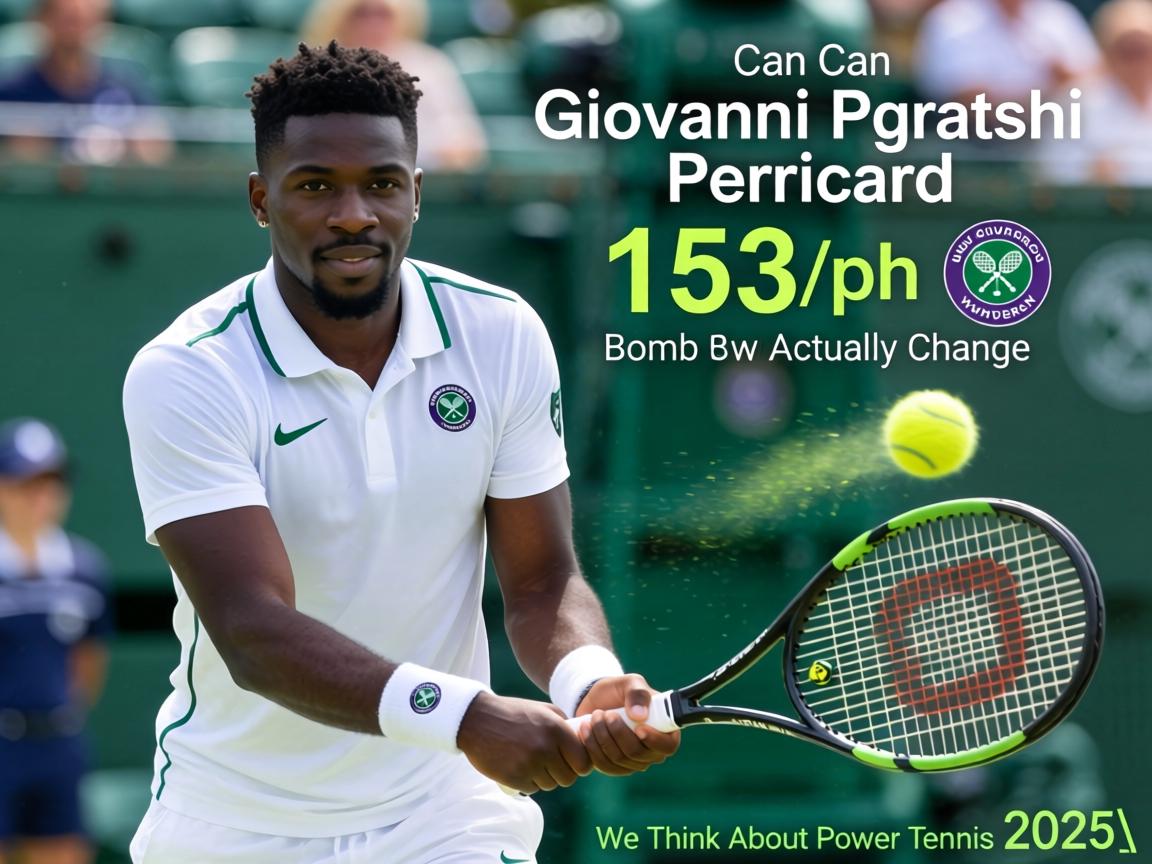
So here’s something that made me stop mid-coffee last week. Giovanni Mpetshi Perricard just clocked a 153 mph serve at Wimbledon
—yeah, you read that right, 153 miles per hour—and suddenly everyone’s asking whether we’re watching the future of men’s tennis unfold in real time. I mean, guys, that’s faster than most of us drive on the highway, and he did it on Centre Court with the roof closed, no less.Let me back up for a second. If you’ve been following the ATP Tour rankings or just casually checking Grand Slam predictions for 2025, you’ve probably noticed this weird tension building up. We’ve got Jannik Sinner and Carlos Alcaraz
basically running a duopoly on major titles—together they snagged all four Slams in 2025, splitting them evenly with two apiece. But then you’ve got these absolute units like Mpetshi Perricard, Ben Shelton
, and Reilly Opelka
serving missiles that make you wonder if pure power might actually disrupt the baseline chess match we’ve been watching.Here’s what I think is happening. The tennis analytics crowd keeps telling us that consistency and court positioning matter most. And yeah, that’s probably true for 90% of matches. But when someone serves 153 mph
—breaking Taylor Dent’s 15-year Wimbledon record by a full 5 mph—you have to ask: what does this mean for the tour? You might be wondering, “Okay, but did he win the point?” Here’s the funny thing—he didn’t
. Taylor Fritz actually got his racquet on that record-breaking bomb and won the point with a volley. Which kinda proves what a lot of coaches have been saying forever: raw speed without placement is just… noise. But still. The psychological impact? That’s real.Let’s be real for a moment. I watched that match live (well, streaming at 3 AM, but same thing), and the audible gasp from the crowd when that serve registered on the speed gun—that’s the kind of moment that builds fan engagement. Tennis needs moments like this. We talk about serve speed records
and fastest tennis serves
because they’re visceral. You don’t need to understand spin rates or court geometry to appreciate 153 mph.So here’s where I want to break this down a bit. A lot of fans ask me whether we’re entering a new era of “power tennis” that could actually challenge the Sinner-Alcaraz dominance. Let me throw some numbers at you:
| Player | Height | Career High Ranking | Best Slam Result | Max Serve Speed |
|---|---|---|---|---|
| Mpetshi Perricard | 6’8″ (2.03m) | No. 36 | 4th Round (Wimbledon 2024) | 153 mph
|
| Ben Shelton | 6’4″ (1.93m) | No. 14 | SF (US Open 2023) | 149 mph |
| Reilly Opelka | 6’11” (2.11m) | No. 17 | SF (US Open 2021) | ~146 mph |
| John Isner | 6’10” (2.08m) | No. 8 | SF (Wimbledon 2018) | 157.2 mph |
From my view, the data tells a story. These giants can absolutely blow you off the court on any given day. But—and this is crucial—none of them have cracked the top 5 consistently
. Why? Because tennis at the elite level is still about shot tolerance
, movement
, and mental endurance
over best-of-five sets. Mpetshi Perricard’s match against Fritz actually illustrates this perfectly. He won the first two sets in tiebreaks, looked unstoppable, then Fritz ground him down over five sets. But here’s what most people don’t notice. The margins are getting thinner. When Sam Groth
set the all-time record at 163.7 mph back in 2012, that was on the Challenger tour—basically a different sport. Now we’re seeing 150+ mph serves in Grand Slam main draws regularly. The equipment has evolved, the training has evolved, and these young players are optimizing for speed in ways that weren’t possible even five years ago.I keep thinking about what Mpetshi Perricard himself said before Wimbledon. “My game is very fast—big serve, short rallies… on a surface like grass, it can really make a difference.” That’s not just strategy; that’s self-awareness. He knows he’s not going to out-rally Alcaraz from the baseline. His path to victory is through first-strike tennis
, through making opponents uncomfortable, through shortening points before their superior court craft can take over.And honestly? On grass, that strategy makes sense. Look at the Wimbledon 2025 predictions
floating around—experts are still picking Djokovic, Sinner, and Alcaraz as favorites, but there’s growing chatter about Jack Draper
and Holger Rune
as dark horses. Why? Because grass rewards aggression. It rewards the player who can end points quickly before their legs get heavy on those slippery lawns.You might be wondering, will we see a 160 mph serve in our lifetime? The biomechanics suggest it’s possible. The kinetic chain—from leg drive through core rotation to racquet head speed—can be optimized further. But here’s the catch: accuracy drops exponentially as speed increases
. The difference between 140 mph and 153 mph isn’t just 13 mph; it’s the difference between hitting a dime and hitting a dinner plate.What does this mean for the tour going forward? I think we’re going to see a bifurcation. The Sinner-Alcaraz rivalry
will likely define this era—two players who can do everything well, who can defend and attack, who can adapt to any surface. But alongside them, we’ll have these specialist power players
who can absolutely wreck a draw on the right day. Think of them as disruptors rather than dominators.Keep reading if you want my honest take on whether this is good for the sport. I think it is. Tennis needs variety. We spent years complaining about homogeneous baseline grinding, about every match looking the same. Now we’ve got 6’8″ Frenchmen serving 153 mph on Centre Court and 18-year-old Mirra Andreeva
breaking through with craft on the women’s side. That’s balance. That’s interesting.From my view, the real question isn’t whether power tennis will take over—it’s whether these power players can develop the secondary skills to win seven best-of-five matches against elite competition. Mpetshi Perricard is 21. He’s got time to improve his return game, his movement, his point construction. If he does? Watch out. If he doesn’t? He’ll be a trivia question—the guy who served 153 mph but never cracked the top 20.I guess what I’m saying is, don’t overreact to one serve. But don’t ignore it either. The trend lines are clear: tennis is getting faster, players are getting taller, and the serve is becoming more weaponized
. Whether that fundamentally changes who wins Grand Slams? That depends on whether the power guys can learn to play chess while they’re throwing grenades.My prediction? We’ll see at least one “serve-bot” style player reach a Grand Slam final by 2027. Not necessarily win—though that would be wild—but get there. The sport is evolving, and evolution favors specialists who can exploit specific conditions. On fast grass, on quick indoor hard courts, these guys are nightmares to face.So yeah, that 153 mph serve matters. Not because it won the point—it didn’t. Not because it won the match—it didn’t do that either. But because it showed us where the ceiling might be. And in a sport obsessed with margins, knowing the ceiling exists is half the battle.What do you guys think? Are we sleeping on the power revolution, or is this just a sideshow to the real story of Sinner vs. Alcaraz? Drop your takes below—I read every comment.