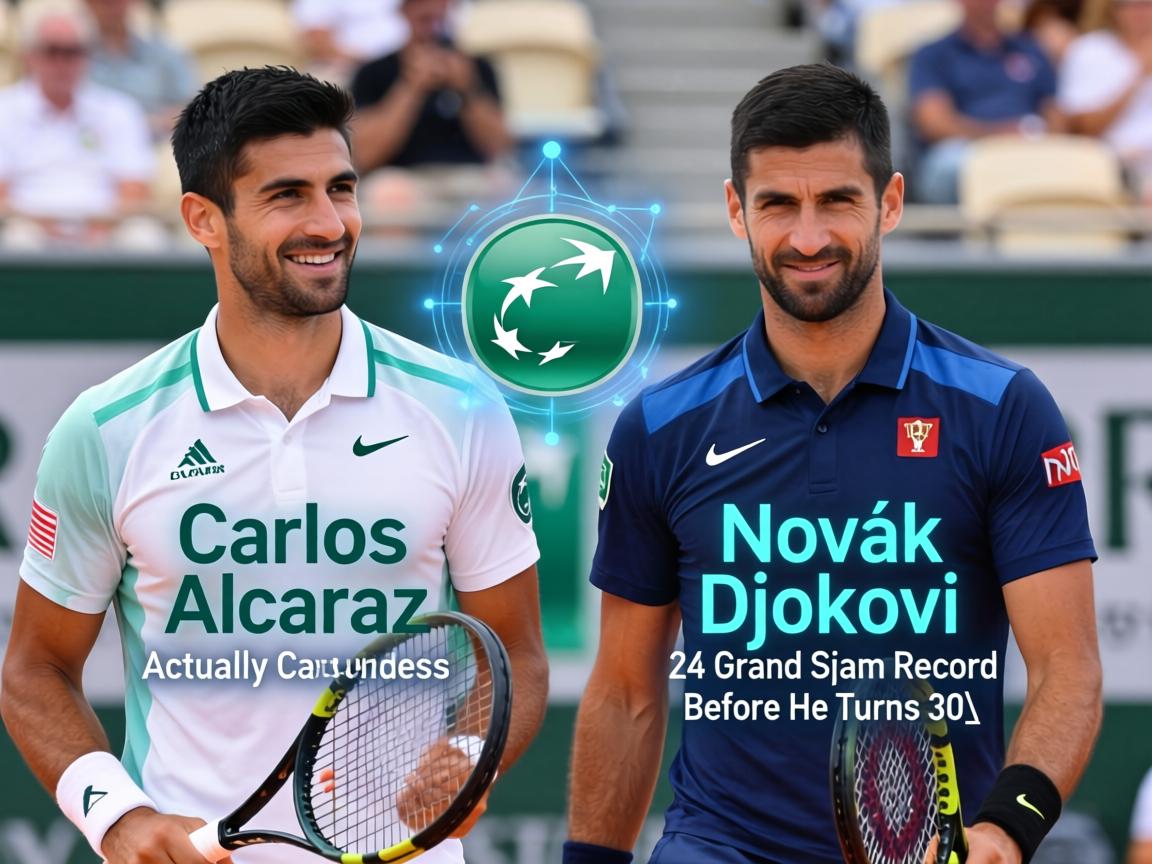
Alright guys, let’s be real for a second. We’re watching something special happen in men’s tennis right now, and if you’re not paying close attention to Carlos Alcaraz, you might be missing the most important storyline of the next decade. The Spaniard just turned 21, already has four Grand Slam titles in his trophy case, and shows absolutely no signs of slowing down. But here’s the burning question that keeps popping up in tennis forums, podcast discussions, and honestly, in my own head at 2 AM: Can this kid actually chase down Novak Djokovic’s seemingly untouchable record of 24 major championships?I know, I know. It sounds crazy on paper. Twenty-four. That’s not just a number—that’s Mount Everest with a tennis racket. But let’s break this down properly because the math, while daunting, isn’t as impossible as your first reaction might suggest.The Numbers Game: Where Alcaraz Stands Now
Right now, Alcaraz sits at 4 Grand Slam titles
. Djokovic hit that same mark back in 2011 when he was… wait for it… also 24 years old. Here’s where it gets interesting though—Alcaraz is ahead of Djokovic’s pace in some ways, behind in others. Let me explain.When Novak was 21, he had exactly one
Grand Slam title. The Serb’s explosion came later, really hitting his stride in his mid-20s. Alcaraz, meanwhile, grabbed his first at the 2022 US Open, defended like a champion at Wimbledon 2023, then added the 2024 French Open and another Wimbledon to his collection. That’s four by age 21. The historical comparison here actually favors the young Spaniard when you look at the all-time greats.But—and this is a big but—Djokovic’s longevity is what created the 24-title monster we’re talking about. The guy is still winning Slams at 37. Thirty-seven! That’s practically ancient in tennis years. So Alcaraz doesn’t just need to match Djokovic’s peak; he needs to match his durability, his ability to stay healthy, motivated, and elite for nearly two decades.What Does Alcaraz Need to Do? The Math
Let’s do some quick calculations, and I’ll keep it simple. Alcaraz turns 22 in May 2025. To reach 25 Slams (just to pass Djokovic), he needs 21 more titles. If he plays until he’s 35—a reasonable assumption for a modern athlete with sports science on his side—that gives him roughly 13 years of contention.Twenty-one majors divided by 13 years equals about 1.6 Slams per year
. That’s it. Roughly 6 or 7 titles every four years. Sounds manageable, right? Well, here’s what most people don’t notice about that stat: only three men in history have ever averaged more than 1.5 Slams per year over a decade-plus stretch. Federer did it. Nadal did it. Djokovic obviously did it. That’s the entire list.So Alcaraz needs to join arguably the most exclusive club in sports history just to have a shot. No pressure, kid.The Competition Factor: Who’s Standing in His Way?
You might be wondering about the current landscape. Who’s actually stopping Alcaraz from running rampant through the draws? Let’s look at the threats:• Jannik Sinner
– The Italian just won the 2024 Australian Open and US Open, and their rivalry is already shaping up to be this generation’s defining matchup. These two might trade Slams for the next decade, which actually helps Alcaraz’s longevity case—rivalries keep you sharp.• The old guard remnants
– Djokovic isn’t done yet, and you know he wants that 25th title. Nadal’s farewell tour continues through 2024. These guys are still dangerous in best-of-five sets.• The next wave
– Holger Rune, Ben Shelton, and a handful of other 20-somethings are hungry. Tennis has never been deeper talent-wise.From my view, the Sinner rivalry is actually the key variable here. If these two push each other to new heights like Federer-Nadal or Djokovic-Nadal did, both could end up with 20+ majors. If one dominates the other, we might see a single player hoarding titles.The Physical Question: Can His Body Hold Up?
Here’s what I think about most when projecting Alcaraz’s future, and it’s what keeps me up at night as a fan of his game. The kid plays explosive tennis
. We’re talking 130 mph forehands, full-court coverage that makes you tired just watching, and that signature drop shot that requires incredible touch and acceleration.That style is beautiful. It’s also brutal on the body.We’ve already seen some warning signs. The 2023 end-of-season injury that cost him the ATP Finals. The occasional muscle tweaks that remind us he’s human. Djokovic’s genius wasn’t just his tennis—it was his physical maintenance, his flexibility, his almost supernatural ability to avoid serious injury for 15+ years at the top.Alcaraz needs to evolve. He needs to learn—like Nadal did—to win without always being the most athletic player on court. He needs to develop Plan B, C, and D for when his legs aren’t cooperating. The good news? He’s already showing signs of that evolution. His 2024 Wimbledon victory featured more serve-and-volley, more efficiency, more “easy” holds. That’s encouraging.The Mental Game: Handling the Pressure
A lot of fans ask me whether Alcaraz has the temperament for a 20+ Slam career. It’s a fair question. We’ve seen talented youngsters crumble under expectations before. But honestly? The signs are overwhelmingly positive.This is a guy who won his first major final in a fifth-set tiebreak against Casper Ruud, then backed it up by beating Djokovic himself in a Wimbledon final the following year. He doesn’t shrink from big moments. If anything, he seems to grow into them, playing his best tennis when the stakes are highest.That said, chasing history brings a different kind of pressure. When you’re at 18 Slams and every tournament becomes “one step closer to the record,” that’s a psychological weight that only Djokovic has really navigated successfully. We’ll see how Alcaraz handles that when—not if—it arrives.The Surface Distribution: Where Will He Stack Titles?
Let’s get specific about where these hypothetical 21 additional Slams might come from. Alcaraz’s current breakdown:• Wimbledon
: 2 titles (2023, 2024) – He’s already established himself as the best grass-court player in the world. Could easily end up with 6-8 Wimbledon crowns if he stays healthy.• US Open
: 1 title (2022) – Hard court is his least dominant surface statistically, but he’s still elite here. Figure 4-5 US Opens over his career?• French Open
: 1 title (2024) – Clay is interesting. Nadal’s shadow looms large, but Rafa’s retiring soon. Alcaraz could own Roland Garros for the 2030s. Let’s say 5-6 French titles?• Australian Open
: 0 titles – This is the gap in his resume. Melbourne’s hard courts play differently than New York, and he’s had some puzzling early exits there. He needs to solve this puzzle to chase the record.Add those projections up—8 Wimbledons, 5 US Opens, 6 French Opens, 4 Australian Opens—and you’re at 23. Close, but not quite there. He needs to overperform somewhere, or stay competitive into his mid-30s to grab a few more.What History Tells Us About Chasing 24
Here’s a comparison table that puts this in perspective:
| Player | Slams by 21 | Final Slam Total | Career Span |
|---|---|---|---|
| Bjorn Borg | 11 | 11 (retired at 26) | 8 years at top |
| Pete Sampras | 0 | 14 | 14 years winning Slams |
| Roger Federer | 1 | 20 | 15 years winning Slams |
| Rafael Nadal | 6 | 22 | 18 years winning Slams |
| Novak Djokovic | 1 | 24* | 18+ years winning Slams |
| Carlos Alcaraz
|
4
|
?
|
Just beginning
|
*Djokovic still active as of 2024The pattern here? Early success doesn’t guarantee late-career accumulation. Borg was done by 26. Sampras won his last at 31 and retired two years later. Even Federer, who seemed immortal, only won one Slam after age 31.Djokovic and Nadal are the outliers—the guys who kept winning into their mid-30s and beyond. That’s the template Alcaraz must follow, and it’s a rare one.My Honest Take: Is It Possible?
Look, I’ve been covering tennis for a long time, and I’ve learned never to say never. Twenty years ago, people thought Sampras’s 14 Slams was untouchable. Then Federer blew past it. Then Nadal. Then Djokovic made 24 look almost casual.Alcaraz has the tools. The forehand is a weapon of mass destruction. The drop shot is already legendary. His movement is generational, even by the absurd standards of modern tennis. And perhaps most importantly, he seems to genuinely love the sport, the competition, the grind of it all. That matters when you’re 30 and have already made $100 million—will you still want to wake up at 6 AM to train?If I had to bet, I’d say he gets to 18-20 Slams
. That puts him in the conversation with Federer and Nadal, which is incredible company. But 24? That requires everything to go right. No major injuries. No loss of motivation. A continued evolution of his game. And probably some luck with the draw and his competition.Twenty-four is the number that might stand for decades, the way Margaret Court’s 24 did in the women’s game before Serena came along. Alcaraz might be the guy to chase it down. He might fall short and “only” end up with 15 or 16, which would still make him an all-timer.Either way, we’re witnessing the beginning of what should be a fascinating 15-year journey. Keep reading, keep watching, and appreciate what we’re seeing. Records are made to be broken, but they’re also made to be chased—and Carlos Alcaraz is chasing.