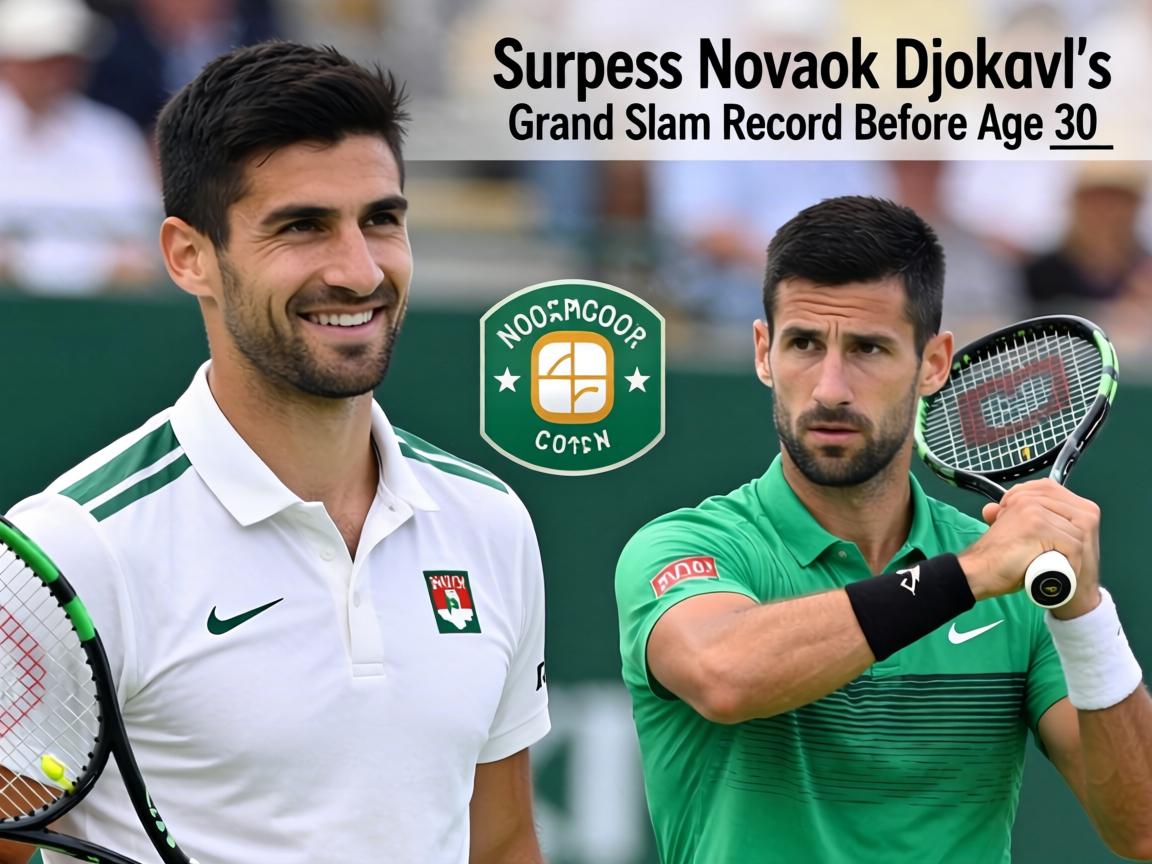
So here’s the thing, guys—every time we talk about the future of men’s tennis, the same question keeps popping up in my DMs and comment sections. “Is Alcaraz the real deal?” “Could he actually break the all-time records?” And honestly? It’s not as crazy as it sounds. Carlos Alcaraz, at just 21 years old, has already racked up 4 Grand Slam titles
, including that historic Wimbledon victory over Djokovic himself in 2023. That match still gives me chills. But when you stack his numbers against the Big Three era
—Federer, Nadal, and that machine Djokovic—you start wondering if we’re witnessing something truly special or just another talented kid who peaked early.Let me break this down with some raw data because, let’s be real, tennis fans love their stats. Djokovic currently sits at 24 Grand Slam singles titles
, the men’s all-time record. Nadal has 22, Federer retired with 20. Alcaraz, born in 2003, turned pro in 2018 and won his first major at the 2022 US Open. So he’s averaging roughly 2 majors per year
since his breakthrough. If he maintains that pace—and that’s a massive “if” in professional tennis—he’d need about 10 more years
to catch Djokovic. That puts him at age 31, which sounds doable until you remember how brutal this sport is on the body.You might be wondering, what makes this comparison even worth discussing? Well, Djokovic didn’t win his 4th major until age 23. Alcaraz got there at 21. The speed of accumulation matters here. But here’s what most people don’t notice—Djokovic’s consistency across all surfaces is almost supernatural. The guy won majors on hard court, clay, and grass with equal dominance. Alcaraz has shown versatility too, conquering US Open hard courts
and Wimbledon grass
, plus that French Open clay title
in 2024. Surface diversity is crucial for longevity in the Slam race.Now let’s talk about the elephant in the room. Injuries. Alcaraz has already dealt with physical setbacks
that cost him tournaments and momentum. His 2023 season had stretches where he looked unbeatable, then suddenly he’s pulling out of events with muscle issues. Djokovic, meanwhile, basically invented modern tennis fitness. The Serbian’s body maintenance and recovery protocols are legendary. At 36, he’s still competing for Slams. Can Alcaraz’s physique hold up through potentially 15 more years of grinding best-of-five matches? From my view, that’s the biggest question mark hanging over this entire debate.A lot of fans ask me about the competition factor too. “Is Alcaraz facing weaker opponents than Djokovic did?” It’s complicated. The current field has Sinner, Rune, Zverev, Medvedev
—legitimate threats, no doubt. But Djokovic spent his prime battling prime Federer and prime Nadal simultaneously. That level of competition was historically unprecedented. Alcaraz benefits from a transitional period where the old guard is fading but the new generation hasn’t fully consolidated. That window won’t stay open forever. Sinner is improving rapidly, and by 2026-2027, we might see a completely different landscape.Here’s what I think about the numbers game. Let’s do some quick math with a comparison table because why not:
| Player | Age at 4th Slam | Current Slam Total | Average Slams/Year (Career) |
|---|---|---|---|
| Alcaraz | 21 | 4 | ~0.8 |
| Djokovic | 23 | 24 | ~1.3 |
| Nadal | 22 | 22 | ~1.1 |
Wait, those averages look weird, right? That’s because I’m calculating from pro debut, not from first Slam win. If we start counting from first major victory, Alcaraz’s rate jumps significantly. But rates fluctuate. Djokovic had years where he won 3 Slams, then years with zero. Tennis careers aren’t linear.What does this mean for the tour going forward? If Alcaraz stays healthy and motivated, 15-18 Slams feels realistic. Breaking 24? That requires almost everything going right—no major injuries, no loss of motivation, sustained excellence against evolving competition for another decade
. Djokovic himself has said Alcaraz has the complete package, but even the most gifted players face unexpected obstacles. Think about how many “next big things” we’ve seen flame out after early promise.The mental aspect fascinates me too. Djokovic’s psychological resilience is arguably his greatest weapon. The guy saves match points like it’s casual practice. Alcaraz shows flashes of that clutch mentality—the 2023 Wimbledon final proved he can stare down the greatest pressure and deliver. But maintaining that intensity across 60+ major tournaments? That’s where legends separate themselves from very good players.Let’s be real about one thing. The media loves coronating the “next GOAT” prematurely. We’ve seen this movie before with various young talents. Alcaraz is different, though. His all-court game, defensive scrambling, and offensive transitions
resemble a hybrid of Nadal’s athleticism and Federer’s creativity, with some unique modern twists. That playing style theoretically ages well if he manages the physical toll.From a fan perspective, I hope he makes the chase interesting. Tennis needs compelling narratives, and a legitimate Slam race would dominate headlines for years. But predicting 20+ future majors for any player, even one this talented, feels like betting on lightning striking repeatedly in the same spot. The sport evolves, bodies break, priorities shift. Some players discover life outside tennis and lose that obsessive edge. Others get derailed by random injuries or unexpected challengers.Keep reading if you want my honest bottom line. I think Alcaraz wins 8-12 Grand Slams total
, which makes him an all-time great but probably short of the record. Djokovic’s 24 feels increasingly like the modern benchmark that might stand for decades, similar to how Sampras’s 14 looked untouchable until Federer came along. But hey, I’ve been wrong before. The beauty of sports is that predictions mean nothing once the players step on court. What actually happens will be determined by thousands of invisible factors—training decisions, draw luck, mental health, coaching relationships, and plain old randomness.So can he surpass Djokovic before 30? Mathematically possible. Realistically? I’d put it at maybe 15% probability
. But watching him try will be absolutely worth your time. The journey matters more than the destination anyway, right? At least that’s what we tell ourselves when records look impossible to break.