
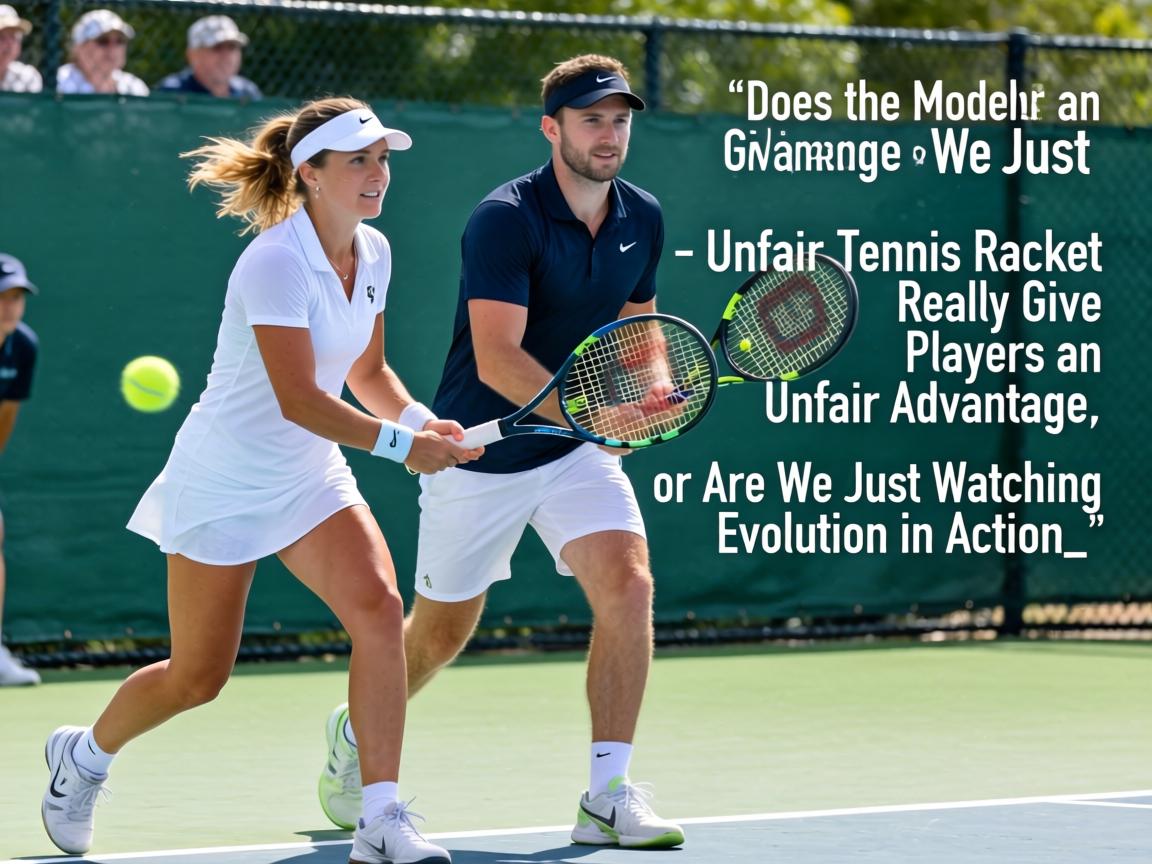


Guys, let’s be real for a second. When you watch Carlos Alcaraz whip a 100mph forehand winner down the line, or see Iga Świątek generate spin that makes the ball bounce shoulder-high, do you ever pause and wonder—is it the player, or is it the gear?
This question has been bouncing around tennis forums for years, and honestly? It’s more complicated than most fans realize.I’ve spent the last few weeks digging into racket technology, talking to stringers, watching old matches, and scrolling through way too many Reddit threads. Here’s what I think: we’re not giving enough credit to the athletes themselves
, but we also can’t ignore how much the equipment has changed the game. Let me break this down.What Has Actually Changed in Racket Tech?
You might be wondering what makes modern rackets so different from the wooden frames of the 70s. Well, everything. Literally everything.
- Materials
: Graphite and carbon fiber composites replaced wood and steel. This means lighter frames that can still generate massive power.
- Head size
: Most pros now use rackets between 95–100 square inches. Compare that to Björn Borg’s tiny 65-square-inch wooden head—yeah, the sweet spot was basically a coin.
- String technology
: Polyester strings, introduced widely in the late 90s, let players hit with extreme topspin
without losing control. Rafael Nadal’s game wouldn’t exist without this.
- Weight distribution
: Modern rackets are head-light but still pack punch, allowing for faster swings and better maneuverability at the net.
A lot of fans ask me: does this mean today’s players have it easier? Not exactly. The rackets are more forgiving on mishits, sure. But the speed of the game has increased so dramatically
that reaction times matter more than ever. You’re not just returning a ball; you’re countering 130mph serves with spin that curves like a breaking ball.The Numbers Don’t Lie
Let’s look at some data that caught my attention. In 1990, the average men’s first serve speed at Wimbledon was around 107mph
. By 2023? It’s pushing 118mph
. That’s not just better athletes—that’s equipment enabling mechanics that were physically impossible with old gear.But here’s where it gets interesting. From my view, the real advantage isn’t raw power. It’s spin rate
. Studies (and yeah, I’ve read the boring physics papers so you don’t have to) show that polyester strings can increase RPMs by 30–40%
compared to natural gut. That’s why we see these ridiculous bouncing forehands that push opponents five feet behind the baseline.What does this mean for the tour? It means the game has shifted from serve-and-volley to baseline grinding. Pete Sampras could finish points at the net; Novak Djokovic wears you down from the back court. Both are valid strategies, but only one works with modern technology.Is It Really “Unfair” Though?
This is where I get a bit controversial. Most people don’t notice that every era had its technological edges
. Wooden rackets in the 60s? They favored touch players like Rod Laver. The introduction of oversized heads in the 80s helped baseliners like Andre Agassi. We’ve always adapted.The difference now is the rate of change
. Racket companies drop “game-changing” models every year. Strings get slicker. Frames get stiffer. Players are essentially beta-testing equipment mid-season, which feels… weird? Like, should a Grand Slam title depend on whether you switched to the new Babolat prototype?I talked to a stringer who works with a top-50 player, and he told me something that stuck: “The racket is maybe 10% of the equation. The other 90% is the hours they put in.”
That feels about right. You could give me Federer’s actual racket, strung exactly like his, and I’d still double-fault my way out of a local club tournament.The Comparison We Need to See
Let me lay out what I’m talking about with a simple breakdown:
| Aspect | 1990s Tennis | 2020s Tennis |
|---|---|---|
| Avg. rally length | 3–4 shots | 6–8 shots |
| Primary surface | Grass/Fast hard courts | Slow hard courts/Clay |
| Winning strategy | Serve big, attack net | Defend, outlast, spin |
| String type | Natural gut dominant | Polyester/co-poly hybrid |
| Racket weight | Heavier, 340g+ | Lighter, 305–320g |
| Fitness demand | Explosive bursts | Marathon endurance |
See the pattern? The equipment didn’t just change how players hit—it changed what kind of athlete succeeds
. Today’s tour rewards physical tanks who can grind for four hours. Is that better or worse? Honestly, it’s just different. But I miss the variety of styles sometimes. Remember when you had serve-volley guys, counter-punchers, and dirt-ballers all competing for the same titles? Now it feels like everyone plays the same way, just at different skill levels.What About the “Purists”?
You’ll always find voices—usually on Twitter, usually with profile pictures of wooden rackets—claiming that modern tennis is “ruined.” That it’s just “ping-pong baseline bashing.” And look, I get the nostalgia. There’s something beautiful about a perfectly executed serve-and-volley point.But here’s what I think: evolution isn’t betrayal
. The game changes because people figure out better ways to play within the rules. If polyester strings had existed in 1985, McEnroe would have used them. If larger heads were legal in 1970, Borg would have switched. These guys were hyper-competitive; they weren’t married to wood out of romance.The real question is whether governing bodies should step in. The ITF and ATP have discussed equipment regulations before—limiting string texture, standardizing racket dimensions, that kind of thing. Nothing major has happened yet. Maybe it shouldn’t. Or maybe we’re headed for a future where rackets are so advanced that human skill becomes secondary. That’s the fear, right?My Honest Take
Keep reading if you want the conclusion most bloggers won’t give you: I don’t think the racket is the problem. I think our expectations are.
We want to compare eras like they’re math equations. “Federer beats Sampras because X.” “Serena dominates Evert because Y.” It doesn’t work that way. Sports are contextual. You dominate the era you’re given.That said, I do worry about accessibility. A competitive junior racket setup can cost $400+ with stringing. When I was a kid, you could buy a decent frame for $50 and play the same game as the pros, just worse. Now there’s this equipment arms race starting at age 10, and that feels… wrong? Like we’re filtering talent based on who can afford the gear.So does the modern racket give an unfair advantage? Only if you think progress itself is unfair. The real advantage goes to players who adapt fastest, who experiment with tension and weight and balance until they find their edge. It’s always been that way. The tools change; the hustle doesn’t.What do you guys think? Drop a comment if you’ve tried a modern poly setup and felt the difference, or if you’re still rocking that 20-year-old Pure Drive because “they don’t make ‘em like they used to.” I’ll be reading.