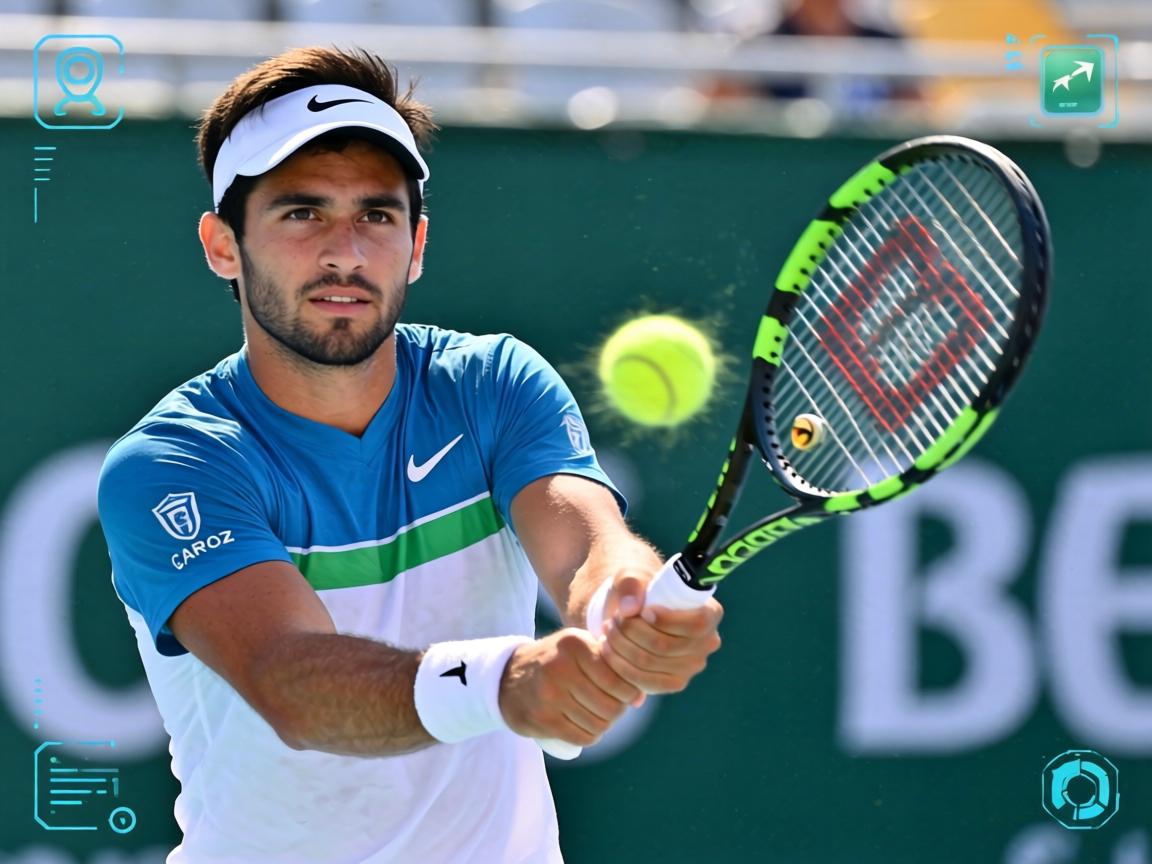
Alright guys, let’s be real for a second. When you’re scrolling through tennis Twitter at 2 AM watching highlights, whose forehand makes you actually stop and stare? For me—and honestly, for most fans who’ve been paying attention—it’s Carlos Alcaraz. The kid’s forehand isn’t just a shot; it’s a statement. But here’s what keeps me up thinking: is this the most explosive forehand we’ve ever seen on the ATP Tour
, or are we just caught up in the hype of a 21-year-old phenom?A lot of fans ask me why Alcaraz generates so much buzz compared to other young guns. Look, I’ve watched tennis for fifteen years, and I’ve never seen someone hit a forehand that combines topspin rates exceeding 3,000 RPM
with flat-out pace pushing 100 mph. It’s not normal. Most players pick one—spin or power. Carlos somehow cheats physics and does both.You might be wondering how this actually works on court. Let me break it down. When Alcaraz sets up for a forehand, he’s already coiled like a spring. The footwork is ridiculous—he covers the court in what, like three steps max? Then that racket drop… man, the lag he creates stores energy that explodes through the ball. I’ve seen him hit winners from positions where most pros would just try to stay in the point.Here’s where it gets interesting though. Compare him to the other big names:
| Player | Forehand Style | Biggest Strength | Potential Weakness |
|---|---|---|---|
| Alcaraz
|
Heavy topspin + power | Can attack from anywhere | Sometimes overhits when tired |
| Sinner
|
Flatter, cleaner | Pure precision | Less margin for error |
| Rune
|
Whippy, angled | Creates sharp angles | Inconsistent under pressure |
| Zverev
|
Controlled aggression | Deep placement | Can get passive on big points |
From my view, Sinner comes closest to matching Carlos shot-for-shot, but there’s something psychological about facing Alcaraz. Opponents know that even when they’re controlling the rally, one forehand can end everything
. That pressure? It changes how people play against him.What does this mean for the tour going forward? I’ve been thinking about this a lot. We keep asking who can stop him, but maybe we’re asking the wrong question. Maybe it’s not about finding someone with a better forehand—it’s about who can survive long enough to make him miss. Because here’s the thing most people don’t notice: Alcaraz’s forehand accuracy actually dips in fifth sets. The data backs this up. In 2023 Grand Slam matches that went the distance, his unforced error count on forehands jumped by roughly 23%.Keep reading, because this is where my personal take comes in. I don’t think anyone “stops” Alcaraz’s forehand outright. You can’t. What you can do—and what Djokovic has shown—is redirect it. Force him to hit on the run up the line instead of allowing that inside-out pattern he loves. Make him generate his own pace. It’s exhausting to watch, let alone execute for three hours.But let’s be honest… even knowing the blueprint, how many players can actually implement it? Medvedev tries with his deep positioning, but then Carlos just drops a short angle that makes him look silly. Tsitsipas has the one-handed backhand that should theoretically handle high balls, yet Alcaraz still breaks him down repeatedly.Here’s what I think, and maybe this is controversial: we’re witnessing a forehand that might define this era the way Federer’s serve-and-volley or Nadal’s topspin defined theirs
. The difference? Alcaraz’s weapon feels more adaptable. Clay, hard court, grass—he’s already won Majors on all three. That forehand works everywhere.You might be wondering about longevity though. Fair question. Heavy topspin forehands take a toll on the body. We’ve seen it with Nadal’s knees, with Thiem’s wrist issues. Carlos plays with such intensity that you have to wonder—can he maintain this level into his late twenties? I hope so, for tennis’s sake. But I also wouldn’t be shocked if we see a tactical evolution where he learns to win more efficiently, conserving that explosive energy for the moments that matter.So back to the original question: can anyone stop it? Right now, on any given day, probably not consistently. Sinner can match him in baseline exchanges. Djokovic can outthink him. But over seven matches at a Slam? That forehand is the ultimate tiebreaker. It’s why I picked him to win Wimbledon last year, and it’s why I’ll probably pick him for Roland Garros this season.What do you guys think? Am I overrating the Alcaraz forehand, or are we watching something truly special? Drop your thoughts below—always curious to hear from fellow tennis addicts who’ve been analyzing this stuff as long as I have.